The hardware and bandwidth for this mirror is donated by METANET, the Webhosting and Full Service-Cloud Provider.
If you wish to report a bug, or if you are interested in having us mirror your free-software or open-source project, please feel free to contact us at mirror[@]metanet.ch.
The radsafer package was developed to provide:
general functions helpful in the practice of radiation safety, for example, decay-corrections
easy access to radionuclide data from the RadData
package
functions for instrumentation and radiation transport modeling
Related functions are identified as members of these families:
decay corrections
radionuclides
radiation measurements
mcnp tools
and a few stand alone functions
Radsafer includes several functions to manage radioactive decay corrections:
dk_correct provides decay-correction of single radionuclides. (Radioactive in-growth is not accounted for.)
dk_correct(RN_select = "Sr-90",
           date1 = "2015-01-01", #Original activity date
           date2 = c("2025-01-01","2035-01-01"), #Decay to these dates
           A1 = 10000) #Original activity (arbitrary units)
#>     RN half_life units decay_mode
#>  Sr-90     28.79     y         B-
#>
#>     RN RefValue    RefDate   TargDate dk_value
#>  Sr-90    10000 2015-01-01 2025-01-01 7860.079
#> Sr-90 10000 2015-01-01 2035-01-01 6178.491dk_correct(half_life = 10, #10 something - need unit
time_unit = "y",#unit is years
date1 = "2010-01-01") #original date is identified
#> half_life RefValue RefDate TargDate dk_value
#> 10 1 2010-01-01 2026-07-14 0.3179556
# Since date2 is not identified, it defaults to the computer's system date "today".dk_correct(RN_select = "Cs-137",
date1 = "2026-01-01", #known activity on this date
date2 = c("2016-01-01","2006-01-01"), #find activity on these earlier dates
A1 = 3000) #original activity (arbitrary units)
#> RN half_life units decay_mode
#> Cs-137 30.1671 y B-
#>
#> RN RefValue RefDate TargDate dk_value
#> Cs-137 3000 2026-01-01 2016-01-01 3775.032
#> Cs-137 3000 2026-01-01 2006-01-01 4749.991dk_time(half_life = 5730, A0 = 14, A1 = 1)
#> [1] 21816.14
RN_find_parent("Po-210")
#> RN
#> 1 At-210
#> 2 Bi-210RadDataPlot an emission spectrum
RN_plot_spectrum(
  desired_RN = c("Pu-238", "Pu-239", "Am-241"), rad_type = "A",
  photon = FALSE, prob_cut = 0.01, log_plot = 0)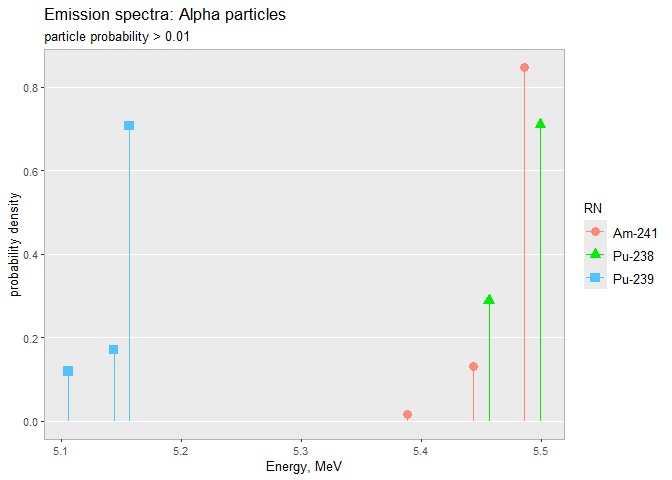
RN_plot_spectrum(
     desired_RN = c("Sr-90", "Y-90"), rad_type = "B-")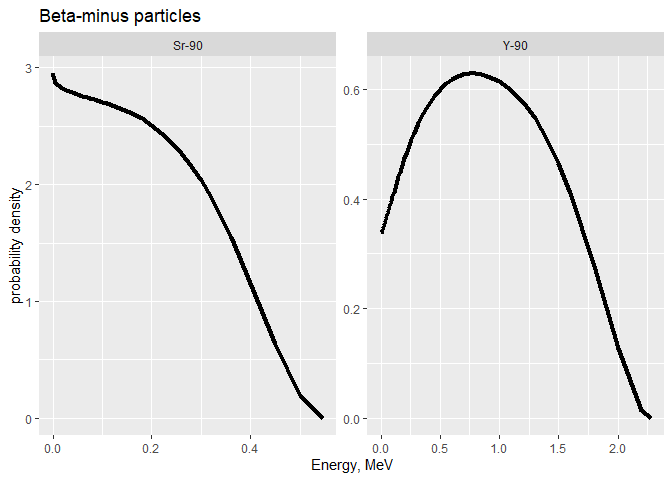
RN_plot_spectrum(desired_RN = c("Co-60", "Ba-137m"), rad_type = "G")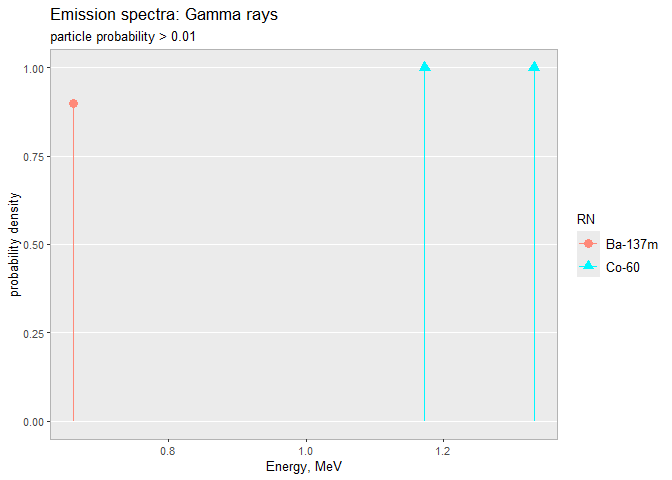
Search by alpha, beta, photon or use the general screen option.
# tight energy limits around 1 MeV
search_results <- RN_search_phot_by_E(E_min = 0.99,
                    E_max = 1.01,
# half-life between 13 and 15 minutes (convert from seconds)
                    min_half_life_seconds = 13 * 60,
                    max_half_life_seconds = 15 * 60,
# only branches with probabilities >= 10%
                    min_prob = 0.1)

RN_plot_spectrum(desired_RN = search_results$RN, rad_type = "G", prob_cut = 0.1)
#> [1] "No matches"disk_to_disk_solid_angle(r.source = 45/2, gap = 20, r.detector = 12.5, runs = 1e4, plot.opt = "2d")
#>    mean_eff         SEM
#>  0.05132699 0.002208406

scaler_sim(true_bkg = 50, true_samp = 10, ct_time = 20, trials = 1e5)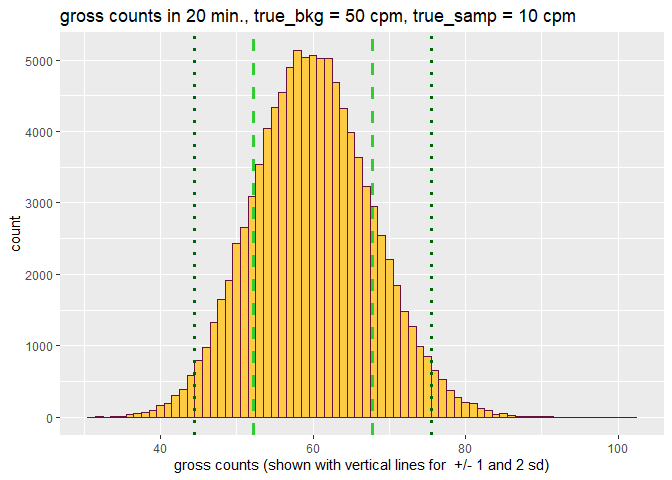
rate_meter_sim(cpm_equilibrium = 270, meter_scale_increments = seq(100, 1000, 20))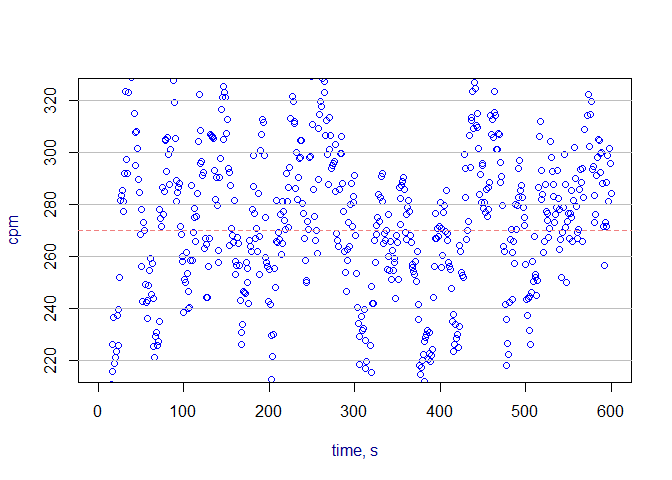
mcnp_sdef_erg_line("Co-60", photon = TRUE, cut = 0.01, erg.dist = 13)
#> # A tibble: 6 × 6
#>   RN    code_AN E_MeV     prob code_num is_photon
#>   <chr> <chr>   <dbl>    <dbl>    <dbl> <lgl>
#> 1 Co-60 G       0.347 0.000075        1 TRUE
#> 2 Co-60 G       0.826 0.000076        1 TRUE
#> 3 Co-60 G       1.17  0.998           1 TRUE
#> 4 Co-60 G       1.33  1.000           1 TRUE
#> 5 Co-60 G       2.16  0.000012        1 TRUE
#> # ℹ 1 more row

mcnp_matrix_rotations("z", 30)
#> [1]  0.8660254  0.5000000  0.0000000 -0.5000000  0.8660254  0.0000000
#> [7] 0.0000000 0.0000000 1.0000000If you encounter a clear bug, please file an issue with a minimal reproducible example on GitHub.
These binaries (installable software) and packages are in development.
They may not be fully stable and should be used with caution. We make no claims about them.