
The hardware and bandwidth for this mirror is donated by METANET, the Webhosting and Full Service-Cloud Provider.
If you wish to report a bug, or if you are interested in having us mirror your free-software or open-source project, please feel free to contact us at mirror[@]metanet.ch.
The sigPCA package provides tools to assess the
statistical significance of principal components using methods from
random matrix theory, particularly the Marchenko–Pastur (MP)
distribution. It also includes an optional permutation-based method for
empirical validation.
#
install.packages("pak")
pak::pak("guillermodeandajauregui/sigPCA")set.seed(123)
X_white <- matrix(rnorm(1000), nrow = 100, ncol = 10)
result_white <- sigPCA(X_white, method = "both", num_permutations = 100)
result_white$mp$significant_components
#> integer(0)
plot_sigPCA(result_white$mp$eigenvalues, result_white$mp$mp_bounds)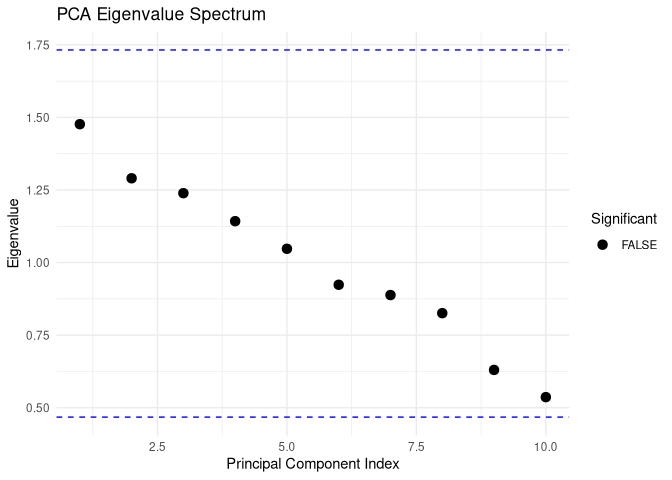
set.seed(456)
{
  n <- 100
  p <- 10
  k <- 2
  latent <- matrix(rnorm(n * k, mean = 3), nrow = n, ncol = k)
  loadings <- matrix(rnorm(p * k), nrow = k, ncol = p)
  noise <- matrix(rnorm(n * p, sd = 0.3), nrow = n, ncol = p)
  X_signal <- latent %*% loadings + noise
  result_signal <- sigPCA(X_signal, method = "both", num_permutations = 100)
}
result_signal$mp$significant_components
#> [1] 1 2
plot_sigPCA(result_signal$mp$eigenvalues, result_signal$mp$mp_bounds)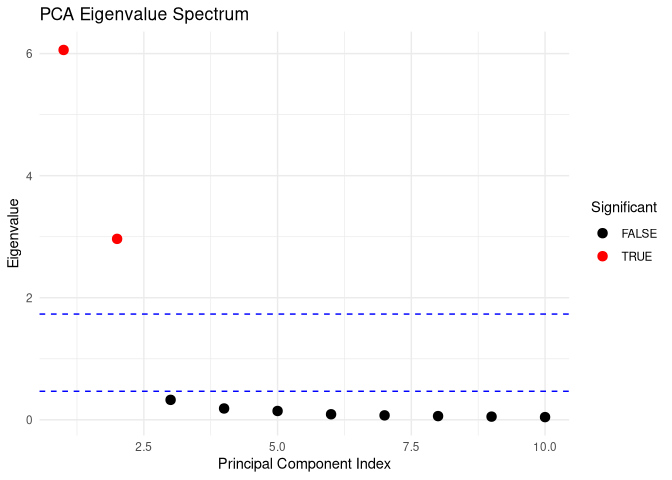
Components with eigenvalues beyond the theoretical Marchenko–Pastur upper bound are considered statistically significant. This method is particularly effective for high-dimensional datasets where traditional heuristics like scree plots may be misleading.
The permutation-based method provides empirical p-values and is useful as a secondary or confirmatory approach.
These binaries (installable software) and packages are in development.
They may not be fully stable and should be used with caution. We make no claims about them.