The hardware and bandwidth for this mirror is donated by METANET, the Webhosting and Full Service-Cloud Provider.
If you wish to report a bug, or if you are interested in having us mirror your free-software or open-source project, please feel free to contact us at mirror[@]metanet.ch.

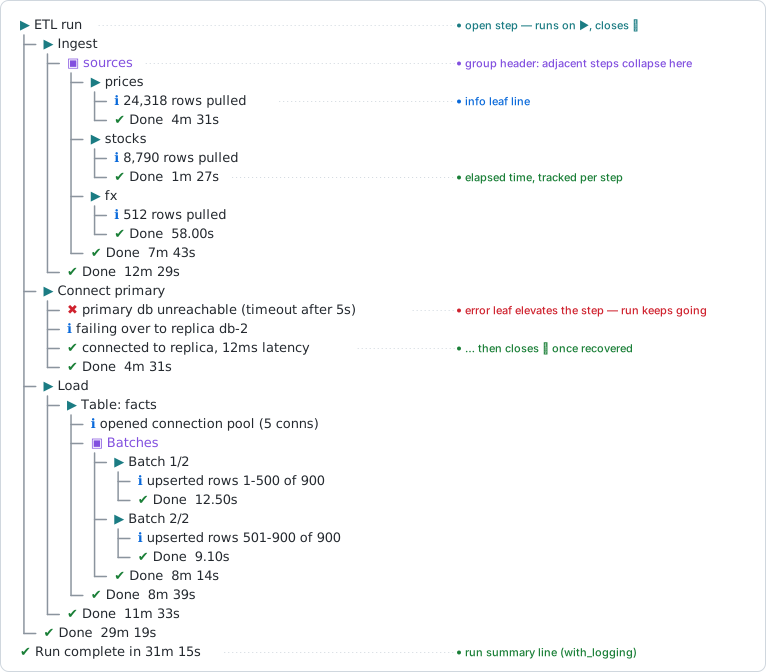
logtree renders nested process execution as a live, colored tree in the console – tree connectors, status glyphs, and elapsed time per step – while keeping nesting depth correct even when a step errors partway through.
logtree isn’t on CRAN yet. Install the development version from GitHub:
# install.packages("pak")
pak::pak("IvanSortino/logtree")Once released to CRAN:
install.packages("logtree")library(logtree)
pipeline <- function() {
log_step("Pipeline")
load_config()
}
load_config <- function() {
log_step("Load config")
log_info("Reading config.yml")
log_success("Validated 12 parameters")
}
pipeline()
#> ▶ Pipeline
#> ├─ ▶ Load config
#> │ ├─ ℹ Reading config.yml
#> │ ├─ ✔ Validated 12 parameters
#> │ └─ ✔ Done 0.00s
#> └─ ✔ Done 0.00slog_step() is meant to be called from inside a function:
the step auto-closes when the function that opened it returns –
normally, early, or via an uncaught error – so nesting depth never gets
stuck out of sync. (At top level, with no function frame to close on,
reach for log_open() / log_close()
instead.)
Five leaf levels – log_debug(), log_info(),
log_success(), log_warn(),
log_error() – plus logtree_threshold() to
filter them. log_warn()/ log_error() also
elevate the enclosing step’s glyph, even when suppressed by verbosity;
step lines always render regardless of threshold.
fetch <- function() {
log_step("Fetch")
log_debug("cache miss for key user:42")
log_info("requesting from API")
log_warn("rate limit at 80%")
log_success("fetched 128 rows")
}
with_logging(fetch(), summary = FALSE) # default verbosity ("info"): debug hidden
#> ▶ Fetch
#> ├─ ℹ requesting from API
#> ├─ ⚠ rate limit at 80%
#> ├─ ✔ fetched 128 rows
#> └─ ⚠ Done 0.00s
logtree_threshold("debug")
with_logging(fetch(), summary = FALSE) # verbosity raised: debug shown
#> ▶ Fetch
#> ├─ ⚙ cache miss for key user:42
#> ├─ ℹ requesting from API
#> ├─ ⚠ rate limit at 80%
#> ├─ ✔ fetched 128 rows
#> └─ ⚠ Done 0.00s
logtree_threshold("info")log_error() from code that itself returns normally
elevates the enclosing step’s glyph but lets the run continue – pass
status = "success" to log_close() once you
know recovery actually worked:
connect_db <- function() {
log_step("Connect primary")
log_error("primary unreachable")
log_info("failing over to replica")
log_success("connected to replica")
log_close(status = "success") # recovered: override the elevated glyph
}
with_logging(connect_db(), summary = FALSE)
#> ▶ Connect primary
#> ├─ ✖ primary unreachable
#> ├─ ℹ failing over to replica
#> ├─ ✔ connected to replica
#> └─ ✔ Done 0.00sA step whose code actually throws is different:
with_logging() marks every currently-open step failed, logs
the condition as a leaf, prints a run summary, then rethrows – it never
silently swallows errors.
apply_migration <- function() {
log_step("Apply migration")
log_info("adding column users.tier")
stop("constraint violation on users.email")
}
try(with_logging(apply_migration()), silent = TRUE)
#> ▶ Apply migration
#> ├─ ℹ adding column users.tier
#> ├─ ✖ constraint violation on users.email
#> └─ ✖ Done 0.00s
#> ✖ Run failed in 0.00sWhen a run ends, logtree_summary() prints a breadcrumb
digest of every error, warning, and pinned leaf since the last reset –
so you see what went wrong without scrolling back through the
tree. filter restricts by status; depth trims
each breadcrumb to its N deepest nodes.
logtree_reset()
migrate <- function() {
log_step("Apply migration")
log_warn("table lock held 800ms")
log_error("constraint violation on users.email")
}
release <- function() {
log_step("Release v2.1")
migrate()
log_step("Smoke test")
log_success("all endpoints 200")
}
with_logging(release(), summary = FALSE)
#> ▶ Release v2.1
#> ├─ ▶ Apply migration
#> │ ├─ ⚠ table lock held 800ms
#> │ ├─ ✖ constraint violation on users.email
#> │ └─ ✖ Done 0.00s
#> ├─ ▶ Smoke test
#> │ ├─ ✔ all endpoints 200
#> │ └─ ✔ Done 0.00s
#> └─ ✔ Done 0.00s
logtree_summary()
#> Summary: 1 error, 1 warning
#> ⚠ Release v2.1 > Apply migration > table lock held 800ms
#> ✖ Release v2.1 > Apply migration > constraint violation on users.emailAdjacent log_step() calls that share a
group = c(name = value) value collapse under one
< name > header instead of stacking as siblings:
check <- function(item, label) {
log_step(label, group = stats::setNames(item, paste0("Item ", item)))
log_info(paste0(label, " running"))
log_success(paste0(label, " ok"))
}
process_item <- function(item) {
check(item, "validate schema")
check(item, "check bounds")
}
run_pipeline <- function() {
log_step("Pipeline run")
for (i in 1:2) process_item(i)
}
with_logging(run_pipeline(), summary = FALSE)
#> ▶ Pipeline run
#> ├─ ▣ Item 1
#> │ ├─ ▶ validate schema
#> │ │ ├─ ℹ validate schema running
#> │ │ ├─ ✔ validate schema ok
#> │ │ └─ ✔ Done 0.00s
#> │ ├─ ▶ check bounds
#> │ │ ├─ ℹ check bounds running
#> │ │ ├─ ✔ check bounds ok
#> │ │ └─ ✔ Done 0.00s
#> │ └─ ✔ Done 0.00s
#> ├─ ▣ Item 2
#> │ ├─ ▶ validate schema
#> │ │ ├─ ℹ validate schema running
#> │ │ ├─ ✔ validate schema ok
#> │ │ └─ ✔ Done 0.00s
#> │ ├─ ▶ check bounds
#> │ │ ├─ ℹ check bounds running
#> │ │ ├─ ✔ check bounds ok
#> │ │ └─ ✔ Done 0.00s
#> │ └─ ✔ Done 0.00s
#> └─ ✔ Done 0.00slogtree_theme() swaps the whole glyph/color preset
("unicode", "ascii", "emoji") or
merges per-glyph overrides onto the active one:
demo_build <- function() {
with_logging({
log_step("Build")
log_info("compiling")
log_warn("3 deprecation warnings")
log_success("build ok")
}, summary = FALSE)
}
logtree_theme("ascii")
demo_build()
#> > Build
#> |- i compiling
#> |- ! 3 deprecation warnings
#> |- + build ok
#> |- ! Done 0.00s
logtree_theme("emoji")
demo_build()
#> 🔹 Build
#> ├─ 💡 compiling
#> ├─ ⚠️ 3 deprecation warnings
#> ├─ ✅ build ok
#> └─ ⚠️ Done 0.00s
logtree_theme("unicode")
demo_build()
#> ▶ Build
#> ├─ ℹ compiling
#> ├─ ⚠ 3 deprecation warnings
#> ├─ ✔ build ok
#> └─ ⚠ Done 0.00sOr override individual slots with overrides – a list
keyed by slot, each holding only the fields to change (everything else
is kept from the active theme):
logtree_theme("unicode", overrides = list(
success = list(glyph = "*", color = c("green", "bold")),
group = list(bracket = TRUE)
))
demo_build()
#> ▶ Build
#> ├─ ℹ compiling
#> ├─ ⚠ 3 deprecation warnings
#> ├─ * build ok
#> └─ ⚠ Done 0.00s
logtree_theme("unicode")Pass compact to tighten the tree’s per-level indentation
– "medium" drops the trailing gap after each connector,
"tight" also slims the connectors down to a single
character:
logtree_theme("unicode", compact = "medium")
demo_build()
#> ▶ Build
#> ├─ℹ compiling
#> ├─⚠ 3 deprecation warnings
#> ├─✔ build ok
#> └─⚠ Done 0.00s
logtree_theme("unicode")The full list of overridable slots (step,
info, success, group,
branch, corner, …) and their fields
(glyph, width, color,
bracket) is in the Themes
section of the vignette and ?logtree_theme.
logtree_sink_file(path, format = c("text", "json")) mirrors
console output to a plain-text or NDJSON file; every registered sink
runs alongside the console sink.logger integration –
logtree_logger() routes the logger package through
logtree in one call, so logger::log_info() and friends
render as logtree leaves.log_open()/log_close() open and close steps by
hand (with an explicit parent) instead of relying on frame
exit, useful at top level or across script blocks. Opening a step at the
same depth as an open one (e.g. sharing a parent) retires
the earlier sibling automatically, so you can stream siblings without an
explicit log_close() on each.log_step()/log_open() key each step on its
label and call site, so re-running the same line re-anchors to that node
instead of nesting deeper on every run. Pass an explicit
key to opt out, or to keep two same-label steps open at
once distinct.See vignette("logtree") and the documentation site for
full details on error handling semantics, manual step control, and the
design philosophy behind the tree renderer.
These binaries (installable software) and packages are in development.
They may not be fully stable and should be used with caution. We make no claims about them.