
The hardware and bandwidth for this mirror is donated by METANET, the Webhosting and Full Service-Cloud Provider.
If you wish to report a bug, or if you are interested in having us mirror your free-software or open-source project, please feel free to contact us at mirror[@]metanet.ch.



Shared Memory for R Objects
→ share() writes an R object into shared memory and
returns a shared version
→ Compact ALTREP serialization — shared objects travel transparently
through serialize() and mirai()
→ Lazy access and automatic cleanup — read on demand; freed by R’s garbage collector
→ OS-level shared memory (POSIX / Win32) — pure C, no external dependencies
install.packages("mori")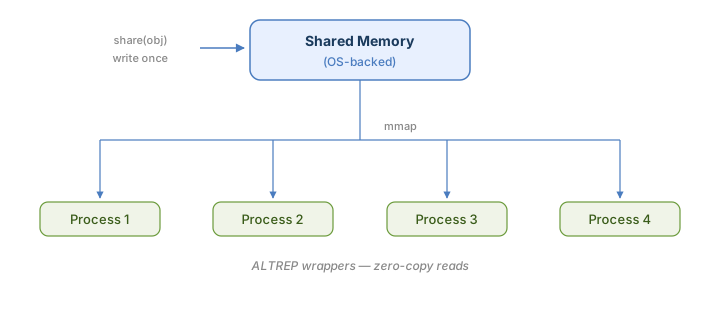
Parallel computing multiplies memory. When 8 workers each need the same 200 MB dataset, that is 1.6 GB of serialization, transfer, and deserialization — with 8 separate copies consuming RAM.
share() writes the data into shared memory once and each
worker maps the same physical pages — turning per-worker copies into
per-worker references.
library(mori)
library(mirai)
library(lobstr)

daemons(8)

# 200 MB data frame — 5 columns × 5M rows
df <- as.data.frame(matrix(rnorm(25e6), ncol = 5))
shared_df <- share(df)
Without mori, each worker holds the full data frame. With mori, each worker holds a small reference into the shared memory region:
mirai_map(1:8, \(i, data) format(lobstr::obj_size(data)),
          .args = list(data = df))[.flat] |> unique()
#> [1] "200.00 MB"

mirai_map(1:8, \(i, data) format(lobstr::obj_size(data)),
          .args = list(data = shared_df))[.flat] |> unique()
#> [1] "824 B"
Avoiding 8 × 200 MB of serialize / deserialize also translates into a significant runtime saving:
boot_mean <- \(i, data) colMeans(data[sample(nrow(data), replace = TRUE), ])

# Without mori — each daemon deserializes a full copy
mirai_map(1:8, boot_mean, .args = list(data = df))[] |> system.time()
#>    user  system elapsed
#>   0.636  12.832   8.424

# With mori — each daemon maps the same shared memory
mirai_map(1:8, boot_mean, .args = list(data = shared_df))[] |> system.time()
#>    user  system elapsed
#>   0.002   0.003   4.787

daemons(0)Workers must run on the same machine as mori shares physical RAM.
shared_name() returns the shared memory name of a shared
object. map_shared() opens that region by name, which is
useful for handing a reference between processes without going through
serialization:
x <- share(rnorm(1e6))

shared_name(x)
#> [1] "/mori_bb52_a9956ee7"
# Another process can map the region by name
y <- map_shared(shared_name(x))
identical(x[], y[])
#> [1] TRUEThe ALTREP serialization hooks emit the same identifier on the wire, so the serialized form is a few bytes regardless of the data size:
length(serialize(x, NULL))
#> [1] 131
This is transparent to any R serialization pathway:
mirai, parallel, callr, and base
R serialize() all carry shared objects as references rather
than copies.
Sub-elements of a shared list serialize as references too. In this case, each element travels as a path into the parent shared region, not as the full data:
daemons(3)

# Share a list — all 3 vectors in a single shared region
lst <- share(list(a = rnorm(1e6), b = rnorm(1e6), c = rnorm(1e6)))

# Each element arrives on the worker as a zero-copy reference
mirai_map(lst, \(v) format(lobstr::obj_size(v)))[.flat] |> unique()
#> [1] "904 B"

daemons(0)All atomic vector types and lists / data frames are written directly
into shared memory, with attributes preserved end-to-end. Pairlists are
coerced to lists. share() returns ALTREP wrappers that
point into the shared memory region. There is no deserialization and no
per-process memory allocation.
All other R objects (environments, closures, language objects) are
returned unchanged by share(), with no shared memory region
created.
A data frame lives in a single shared region. Columns are read on demand, so a worker that needs 3 of 100 columns only loads 3. Character strings are accessed lazily per element.
df <- share(as.data.frame(matrix(rnorm(1e7), ncol = 100)))
shared_name(df)        # one region for all 100 columns
#> [1] "/mori_bb52_a9956ee9"
shared_name(df[[50]])  # sub-path into the same region
#> [1] "/mori_bb52_a9956ee9[50]"Shared memory is managed by R’s garbage collector. The shared memory
region stays alive as long as any shared object backed by it remains
referenced in R — the original returned by share(), or a
column or sub-list extracted from it, in this or another process. When
no references remain, or the session exits cleanly, the shared memory is
freed automatically.
Important: Ensure the return value of
share() is not garbage collected before a consumer can map
its shared memory.
If a process is killed before cleanup can run (a crash,
SIGKILL, or the OOM killer) its region can be left behind.
prune_shared() reclaims such orphans, removing only regions
whose creating process is no longer running.
Shared data is mapped read-only, preventing corruption of the shared region. Mutations are always local — R’s copy-on-write mechanism ensures other processes continue reading the original shared data:
X[1] <- 0) materializes just that vector into a private
copy. Other vectors in the same shared region stay zero-copy.–
Please note that the mori project is released with a Contributor Code of Conduct. By contributing to this project, you agree to abide by its terms.
These binaries (installable software) and packages are in development.
They may not be fully stable and should be used with caution. We make no claims about them.