
The hardware and bandwidth for this mirror is donated by METANET, the Webhosting and Full Service-Cloud Provider.
If you wish to report a bug, or if you are interested in having us mirror your free-software or open-source project, please feel free to contact us at mirror[@]metanet.ch.


A small, dependable client for S3-compatible object stores (AWS S3, MinIO, Garage, Ceph, …), from R. Nine verbs, one configuration, nothing else to learn:
library(s3pe)

use_endpoint("https://s3.example.org")
use_bucket("my-bucket")

meta <- read_s3("data/manifest.json")     # list, from JSON
sales <- read_s3("series/sales.csv.gz")   # tibble, from gzipped CSV
write_s3(sales, "report/sales.parquet")   # Parquet, by extension
list_s3("data/")read_s3() returns
a tibble for .csv, .csv.gz, .tsv,
.parquet and .xlsx, a list for
.json, an sf object for .geojson, the saved
object for .rds, a string for text and raw bytes for
everything else. write_s3() does the reverse.Content-Length.s3pe_error_not_found,
s3pe_error_access, s3pe_error_http,
s3pe_error_transport, s3pe_error_integrity,
s3pe_error_config, all inheriting from
s3pe_error.options(s3pe.quiet = TRUE).The same package exists for Python, Rust (with a command line) and Go, all in the same repository, with the same verbs and the same behaviour.
# CRAN (once accepted)
install.packages("s3pe")

# Development version
pak::pak("StrategicProjects/s3pe/r")Every request needs an endpoint and a key pair. Put them in
~/.Renviron (R reads it at start-up; never put a secret in
a script or a versioned .Rprofile) and restart R:
S3PE_ENDPOINT=https://s3.example.org
AWS_ACCESS_KEY_ID=...
AWS_SECRET_ACCESS_KEY=...
S3PE_BUCKET=my-bucket
S3PE_BUCKET is optional: it is the bucket used when a
key is not an s3://bucket/key URL and no
bucket argument is given. For one session,
use_endpoint() and use_bucket() do the same.
s3_config() shows what was resolved (the secret is never
printed); see ?s3_config for the full table (endpoint,
region, timeout, retries).
s3_config()
#> <s3pe_config>
#>   endpoint:   https://s3.example.org
#>   region:     us-east-1
#>   bucket:     my-bucket
#>   access_key: AKIA…
#>   secret_key: <set>
#>   timeout:    300 s
#> max_tries: 3| Setting | Option | Environment | Default |
|---|---|---|---|
| endpoint | s3pe.endpoint |
S3PE_ENDPOINT, AWS_ENDPOINT_URL |
required |
| region | s3pe.region |
AWS_REGION, AWS_DEFAULT_REGION |
us-east-1 |
| credentials | AWS_ACCESS_KEY_ID, AWS_SECRET_ACCESS_KEY,
AWS_SESSION_TOKEN |
required | |
| bucket | s3pe.bucket |
S3PE_BUCKET |
none |
| timeout, max_tries | s3pe.timeout, s3pe.max_tries |
300 s, 3 |
Requests are path-style (endpoint/bucket/key), which
every S3-compatible store accepts.
A good publisher writes a manifest last: if
manifest.json is there, everything it lists is there too.
Read it first and use its date as the version of the batch.
library(s3pe)
library(dplyr)

use_bucket("my-bucket")

meta <- read_s3("data/manifest.json")
meta$generated_at

series  <- read_s3("data/series.json")
regions <- read_s3("data/regions.geojson")           # sf, when sf is installed
sales   <- read_s3("series/sales.csv.gz", col_types = "Dncl")

# another bucket on the same store: say so in the key
other <- read_s3("s3://other-bucket/series/prices.csv.gz")

list_s3("series/")
#> # A tibble: 12 × 4
#>    key                      size last_modified       etag
#>    <chr>                   <dbl> <dttm>              <chr>
#>  1 series/sales.csv.gz      2831 2026-10-23 07:01:12 9e10…
#>  …
Writing is the same in reverse:
write_s3(panel, "report/panel.parquet")
#> ↑ s3://my-bucket/report/panel.parquet (12.3 MB, 0.8 s)

write_s3(list(generated_at = Sys.time(), rows = nrow(panel)),
         "report/manifest.json", pretty = TRUE)

upload_s3("output/figure1.png", "report/")           # keeps the file name
download_s3("data/regions.geojson", "data/regions.geojson")

exists_s3("report/panel.parquet")
head_s3("report/panel.parquet")
delete_s3("report/draft.csv")
Pass format = when the extension does not say what you
want (format = "raw" always works), and ... to
reach the reader or writer (col_types,
simplifyVector, pretty, na,
…).
Nothing to do: bodies larger than 64 MiB go up as a multipart upload
(16 MiB parts, one by one, aborted on any failure, every part’s ETag
checked). Both knobs live in
s3_config(multipart_threshold =, part_size =) or in
S3PE_MULTIPART_THRESHOLD and
S3PE_PART_SIZE.
upload_s3("exports/full.parquet", "archive/full.parquet", bucket = "my-bucket")
#> ↑ exports/full.parquet → s3://my-bucket/archive/full.parquet (1.2 GB, 48.3 s)
Uploads also take metadata (user metadata, returned by
head_s3()) and headers (any extra header:
Cache-Control, Content-Disposition,
x-amz-storage-class, server-side encryption):
write_s3(sales, "reports/sales.csv", bucket = "my-bucket",
         metadata = c(author = "ana", run = "2026-10-23"),
         headers = c("Cache-Control" = "max-age=3600"))
head_s3("reports/sales.csv", bucket = "my-bucket")$metadata[[1]]$author
#> [1] "ana"A link anyone can use for a while, without credentials:
presign_s3("reports/report.pdf", bucket = "my-bucket", expires = 3600)
#> "https://s3.example.org/my-bucket/reports/report.pdf?X-Amz-Algorithm=..."
presign_s3("incoming/upload.csv", bucket = "my-bucket", method = "PUT") # accept an uploadcopy_s3("etl/sales.parquet", "archive/sales-2026.parquet", bucket = "my-bucket")
delete_s3(list_s3("tmp/", bucket = "my-bucket")$key, bucket = "my-bucket") # one request
list_s3("series/", bucket = "my-bucket", delimiter = "/") # one level
# mirror a directory to a prefix, by ETag; the manifest goes up last
sync_up_s3("output/", "reports/2026/", bucket = "my-bucket",
delete = TRUE, last = "manifest.json")
#> ✔ sync output/ → s3://my-bucket/reports/2026/: 12 uploaded, 30 unchanged, 0 deleted (3.2 s)
sync_down_s3("s3://my-bucket/reports/2026/", "reports-2026/")Network problems are errors, not warnings: a pipeline that depends on the data should stop. Catch them by class when you want to go on:
meta <- tryCatch(
  read_s3("data/manifest.json"),
  s3pe_error_not_found = function(e) NULL,
  s3pe_error_transport = function(e) { message("offline, using cache"); readRDS("cache.rds") }
)| Class | When |
|---|---|
s3pe_error_config |
no endpoint, no credentials, no bucket |
s3pe_error_not_found |
HTTP 404 (exists_s3() and head_s3() turn
it into FALSE/NULL) |
s3pe_error_access |
HTTP 403 |
s3pe_error_http |
any other HTTP error, with $status and
$code |
s3pe_error_transport |
the server could not be reached, after the retries |
s3pe_error_integrity |
the bytes that arrived are not the bytes that were sent |
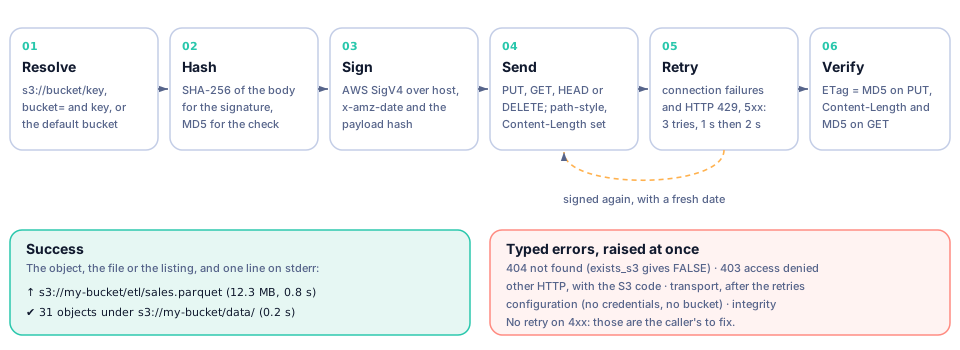
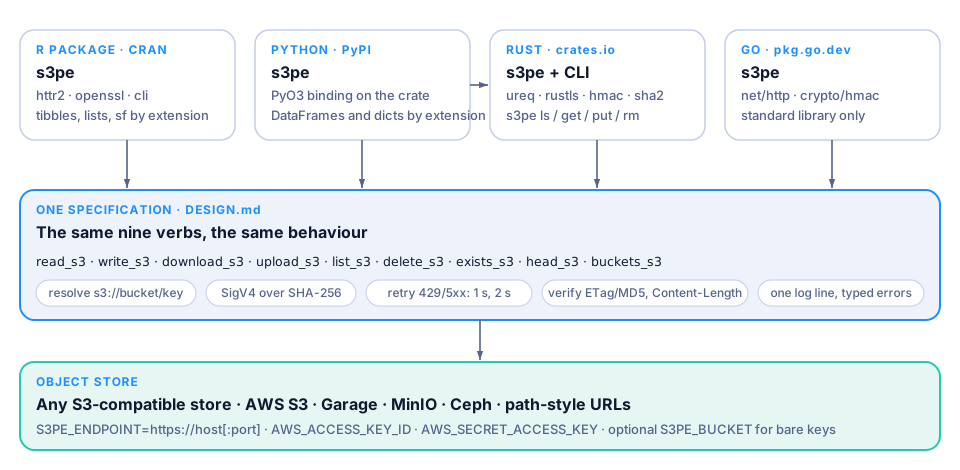
s3pe lê e grava dados em qualquer armazenamento de
objetos compatível com S3 a partir do R: read_s3() e
write_s3() escolhem o formato pela extensão do arquivo
(.csv, .json, .parquet,
.rds, .geojson), upload_s3() e
download_s3() movem arquivos, list_s3(),
head_s3(), exists_s3() e
delete_s3() cuidam do resto. O endpoint e as credenciais
ficam no ~/.Renviron (S3PE_ENDPOINT,
AWS_ACCESS_KEY_ID, AWS_SECRET_ACCESS_KEY),
nunca em scripts. Toda requisição é assinada, repetida em falhas
transitórias e conferida pelo ETag. As mensagens e a documentação estão
em inglês, como nos pacotes irmãos.
s3pe is smaller, picks the format from the extension,
verifies every transfer and never sends the aws-chunked
encoding that some stores reject.s3pe is developed in Recife, Brazil, by the authors listed in
DESCRIPTION.
These binaries (installable software) and packages are in development.
They may not be fully stable and should be used with caution. We make no claims about them.