The hardware and bandwidth for this mirror is donated by METANET, the Webhosting and Full Service-Cloud Provider.
If you wish to report a bug, or if you are interested in having us mirror your free-software or open-source project, please feel free to contact us at mirror[@]metanet.ch.



shewhartr is a tidyverse-native toolkit for Statistical
Process Control (SPC). It implements the classical Shewhart chart family
— variables (I-MR, Xbar-R, Xbar-S) and attributes (p, np, c, u) —
memory-based charts (EWMA, CUSUM), multivariate charts (Hotelling T²,
MEWMA, MCUSUM), and a flagship regression-based control
chart for processes with trend, where stationarity is too
strong an assumption to make.
The package is built around a small set of design choices:
data first, supports tidy-eval column references, and
returns an S3 object that integrates with broom via tidy(),
glance() and augment().calibrate() and monitor() functions make the
distinction between estimation and prospective monitoring impossible to
confuse, following Woodall (2000).locale = "pt"
(or "es", "fr") and chart titles, axis labels,
and legends are translated.limits = "poisson" for exact Poisson quantile limits,
instead of the normal approximation that breaks down at small
means.# Released version from CRAN
install.packages("shewhartr")
# Development version
remotes::install_github("castlaboratory/shewhartr")library(shewhartr)
library(ggplot2)
# Classical I-MR chart on a 100-observation series with a small drift
fit <- shewhart_i_mr(bottle_fill, value = ml, index = observation)
print(fit)
autoplot(fit)| Data type | Chart |
|---|---|
| Individual measurements (no rational subgroup) | shewhart_i_mr() |
| Subgroups of size 2-10 | shewhart_xbar_r() |
| Subgroups of size > 10 or unequal n | shewhart_xbar_s() |
| Proportion of nonconforming | shewhart_p() |
| Number of nonconforming, constant n | shewhart_np() |
| Defect counts, constant inspection size | shewhart_c() |
| Defect counts, variable inspection size | shewhart_u() |
| Process with trend (drift, growth, decay) | shewhart_regression() |
| Small persistent shifts (memory-based) | shewhart_ewma(),
shewhart_cusum() |
| Several correlated variables monitored jointly | shewhart_hotelling() |
The flagship chart for trended processes splits the series into
phases when a runs rule fires, fits a local model in each, and flags
points that depart from the local trend. The example below uses the
COVID-19 mortality series for Recife (cvd_recife), the case
study of Ferraz et al. (2020). A faithful reproduction of the articles’
figures, with limits computed on the log scale
(limits_scale = "model") and the Brazil, Pernambuco and São
Paulo series (cvd_brazil), is in the article-charts
vignette:
fit <- shewhart_regression(
  cvd_recife,
  value       = new_deaths,
  index       = .t,
  model       = "loglog",
  phase_rule  = "we_seven_same",
  rules       = c("nelson_1_beyond_3s", "we_seven_same"),
  lower_bound = 0
)

length(fit$fits)              # number of phases detected
nrow(fit$violations)          # individual flagged observations
autoplot(fit)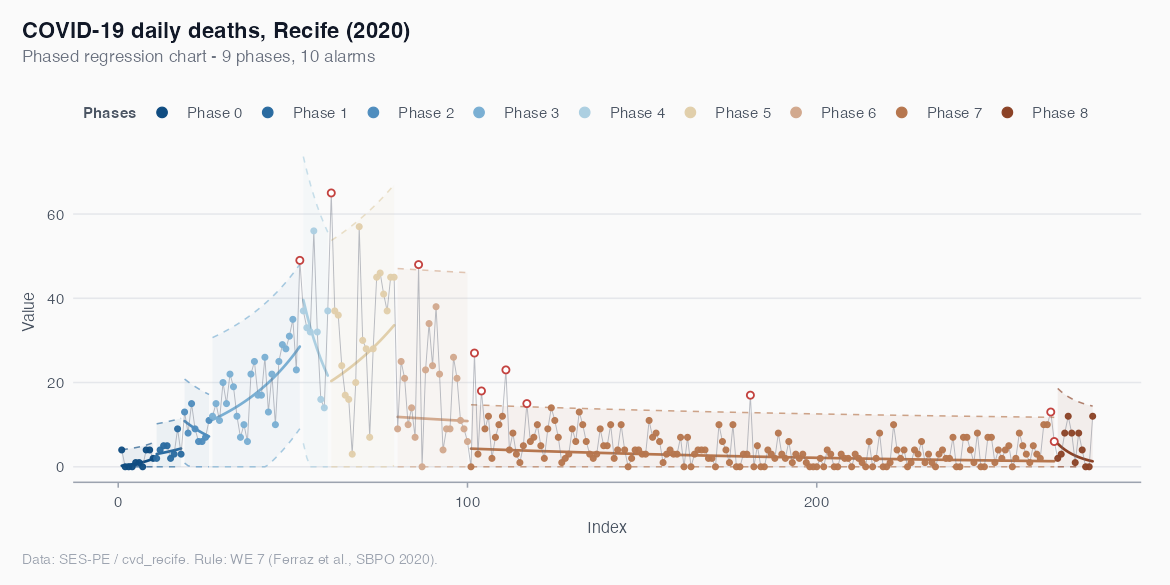
Each shaded band is one phase, the solid line is the local regression centre, the dashed lines are the phase’s 3-sigma limits, and the firebrick points are the days flagged by the rule set as departing from the local trend.
A Shewhart chart serves two different purposes that are easy to conflate. Phase I is retrospective: take historical data, identify out-of-control points, eliminate assignable causes, and arrive at trustworthy estimates of the process mean and variability. Phase II is prospective: take those estimated limits and apply them to new data, signalling alarms when something departs from the established baseline. The package draws this line in code:
# Phase I: estimate limits from a clean baseline
calib <- calibrate(historical_data, value = y,
                   chart = "i_mr", trim_outliers = TRUE)

# Phase II: apply the limits to new data
alarms <- monitor(new_observations, calib)
alarms$violations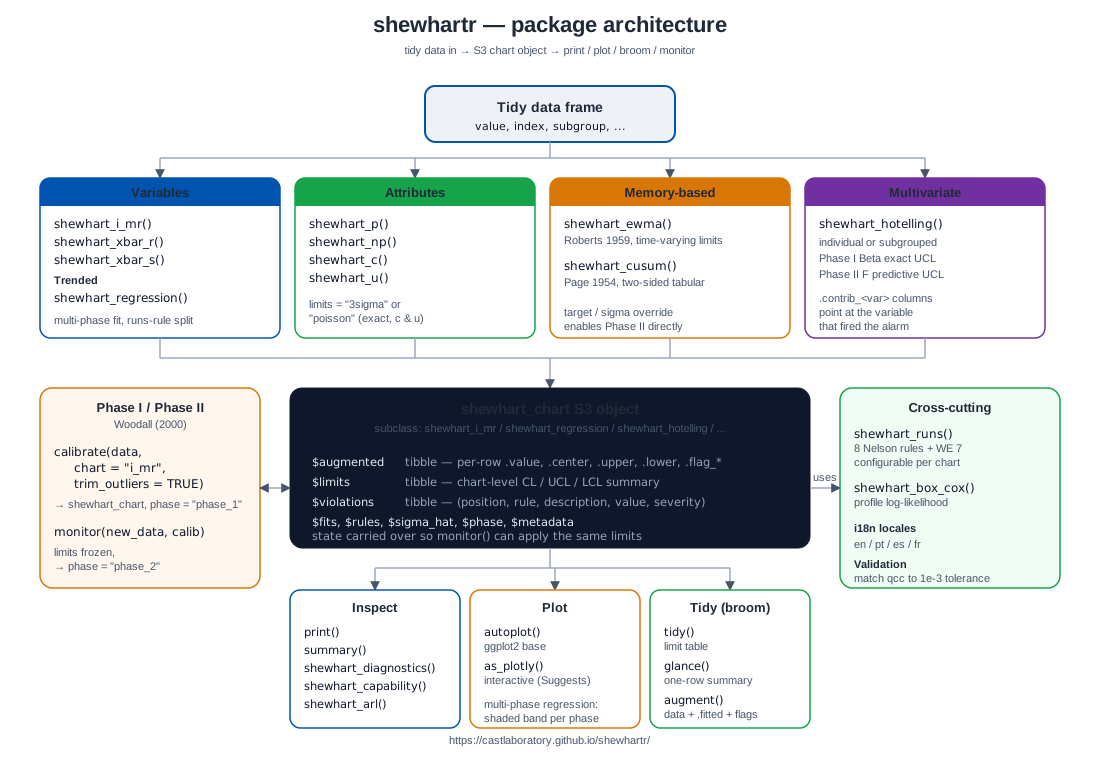
Every chart constructor — variables (shewhart_i_mr,
shewhart_xbar_r, shewhart_xbar_s), attributes
(shewhart_p, shewhart_np,
shewhart_c, shewhart_u), regression
(shewhart_regression), memory-based
(shewhart_ewma, shewhart_cusum), and
multivariate (shewhart_hotelling) — returns a
shewhart_chart S3 object with a uniform layout. The same
object then feeds into:
print(),
summary(), shewhart_diagnostics(),
shewhart_capability(), shewhart_arl().autoplot() (ggplot2) and
as_plotly() (interactive, plotly in
Suggests).broom::tidy(),
glance(), augment().calibrate() produces a Phase
I chart whose limits are frozen by monitor() for
prospective monitoring.The website hosts:
If you use shewhartr in academic work, please cite:
Leite, A., Vasconcelos, H., Ospina, R., & Ferraz, C. (2026). shewhartr: Statistical Process Control with Tidyverse-Native Workflows. R package version 1.4.0. https://castlaboratory.github.io/shewhartr/
These binaries (installable software) and packages are in development.
They may not be fully stable and should be used with caution. We make no claims about them.