
The hardware and bandwidth for this mirror is donated by METANET, the Webhosting and Full Service-Cloud Provider.
If you wish to report a bug, or if you are interested in having us mirror your free-software or open-source project, please feel free to contact us at mirror[@]metanet.ch.


This R package implements a variable neighborhood trust region search (VNTRS) algorithm for nonlinear global optimization, based on Bierlaire et al. (2009) “A Heuristic for Nonlinear Global Optimization”.
The method combines neighborhood exploration with a trust-region framework to search the solution space efficiently. It can terminate a local search early when the iterates converge toward a previously visited local optimum or when further improvement within the current region is unlikely. The algorithm can also be used to identify multiple local optima.
The package implementation differs in some aspects from Bierlaire et al. (2009) as follows:
| Aspect | Bierlaire et al. (2009) | vntrs |
Rationale |
|---|---|---|---|
| Local search | Unconstrained trust-region method | Optionally constrained trust-region method, using damped BFGS when no analytical Hessian is supplied | Allows for parameter bounds, improves numerical stability |
| Scaling | Uses absolute distance and gradient criteria | Uses relative criteria by default;
scale = "absolute" applies unscaled criteria |
Relative criteria reduce scale dependence |
| Interruption | Uses Armijo-like improvement test | Not used | Limited value in addition to other interruption criteria |
You can install the released package version from CRAN with:
install.packages("vntrs")Specify a function f that computes the objective
value. It may also return the gradient and Hessian. Omitted derivatives
are approximated by finite differences.
Call
vntrs::vntrs(f = f, npar = npar, minimize = minimize),
where
npar is the number of parameters of f
and
minimize determines whether f should be
minimized (minimize = TRUE, the default) or maximized
(minimize = FALSE).
Optionally, the algorithm can be tuned by setting control arguments,
see help("vntrs") for details.
The example below minimizes the six-hump camel function over \([-3, 3] \times [-2, 2]\). On this domain, the function has two global minima and four additional local minima.
library(vntrs)
set.seed(1)
camel <- function(x) {
  (4 - 2.1 * x[1]^2 + x[1]^4 / 3) * x[1]^2 + x[1] * x[2] + (-4 + 4 * x[2]^2) * x[2]^2
}
optima <- vntrs(
  f = camel, npar = 2,
  lower = c(-3, -2), upper = c(3, 2), # search bounds
  collect_all = TRUE,                 # also collect local optima
  neighborhoods = 10                  # number of neighborhoods
)
optima
#>            p1         p2      value global
#> 1 -0.08984203  0.7126564 -1.0316285   TRUE
#> 2  0.08984201 -0.7126564 -1.0316285   TRUE
#> 3  1.70360672 -0.7960836 -0.2154638  FALSE
#> 4 -1.70360674  0.7960836 -0.2154638  FALSE
#> 5 -1.60710473 -0.5686515  2.1042503  FALSE
#> 6  1.60710475  0.5686517  2.1042503  FALSE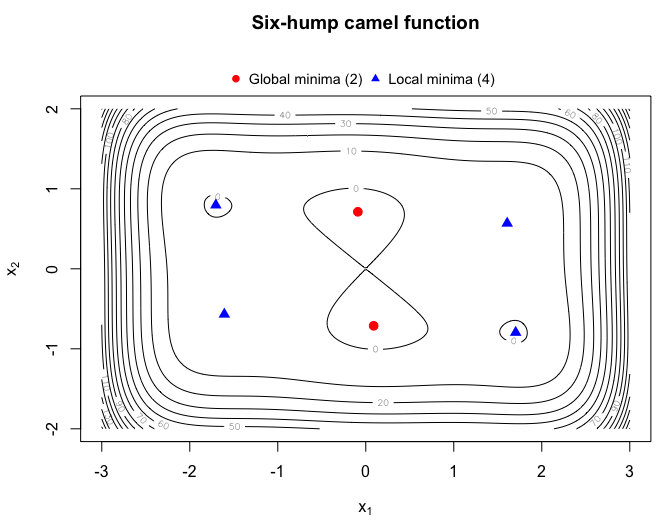
These binaries (installable software) and packages are in development.
They may not be fully stable and should be used with caution. We make no claims about them.