
The hardware and bandwidth for this mirror is donated by METANET, the Webhosting and Full Service-Cloud Provider.
If you wish to report a bug, or if you are interested in having us mirror your free-software or open-source project, please feel free to contact us at mirror[@]metanet.ch.






A production-grade vehicle routing problem (VRP) solver for R.
vrpr brings the state-of-the-art PyVRP solver to R. It vendors PyVRP’s high-performance C++ core and rewires it with cpp11, wrapped in an idiomatic, tidyverse-style API: a pipe-friendly model builder, data in tibbles, and logging via cli — with no Python runtime dependency.
It fills a real gap in the R ecosystem: there are ompr,
ROI, lpSolve, igraph and
dodgr, but no modern, strong, friendly solver for
production vehicle routing.
tools/benchmark/).Install the released version from CRAN:
install.packages("vrpr")Or the development version from GitHub:
# install.packages("pak")
pak::pak("StrategicProjects/vrpr")
A C++20 toolchain is required to build from source (R >= 4.3).
library(vrpr)

clients <- tibble::tibble(
  x = c(10, 25, 40, 15), y = c(5, 30, 12, 22),
  demand = c(10, 15, 8, 12)
)

res <- vrp_model() |>
  add_depot(x = 0, y = 0) |>
  add_clients(clients) |>
  add_vehicle_type(num_available = 3, capacity = 50) |>
  vrp_solve(stop = max_runtime(2))

cost(res)      # objective cost
routes(res)    # tibble: route_id, depot, position, client, vehicle_type, ...
summary(res)   # one-row summary
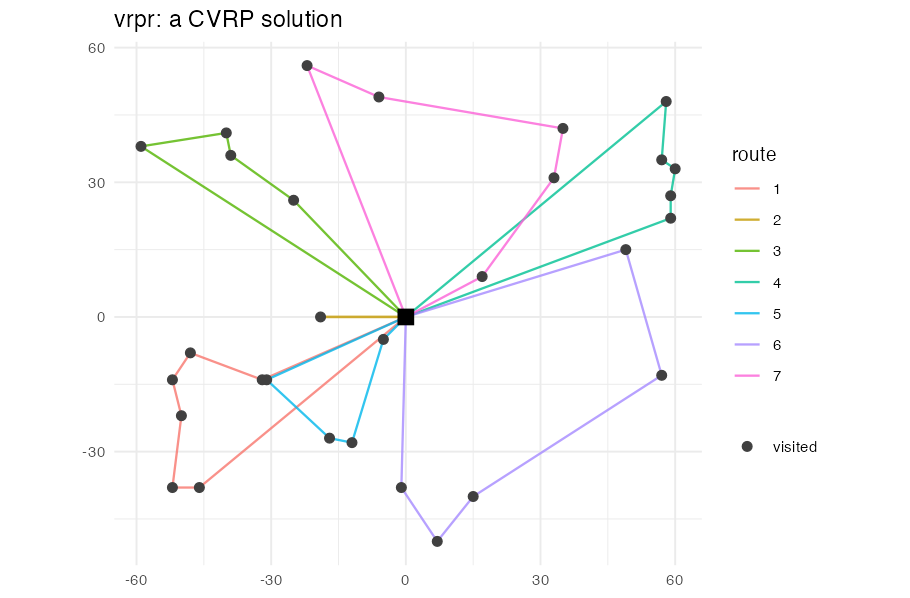
plot(res) # the routes, with {ggplot2}| Variant | How |
|---|---|
| Time windows (VRPTW) | add tw_early, tw_late,
service to clients |
| Heterogeneous fleet | call add_vehicle_type() several times with different
capacities/costs |
| Multiple depots (MDVRP) | several add_depot() +
add_vehicle_type(depot = i) |
| Prize-collecting | required = FALSE + prize on clients;
add_client_group() for exclusive sets |
| Pickup & delivery / backhaul | add a pickup column to clients |
| Paired pickup-and-delivery (PDP) | add_shipments() with pickup/delivery points |
| Multi-trip | add_vehicle_type(reload_depots = i, max_reloads = k) |
See the Getting started guide and the Articles for worked examples of each.
m <- read_vrplib(system.file("extdata", "sample-n6-k2.vrp", package = "vrpr"))
m <- read_solomon(system.file("extdata", "sample-solomon.txt", package = "vrpr"))
res <- m |> vrp_solve(stop = max_runtime(5))

vrpr is a thin, idiomatic R skin over PyVRP’s C++
engine:
vrp_solve().IteratedLocalSearch.src/vendor/pyvrp/, version pinned in
tools/PYVRP_VERSION) — the hot compute: problem data, cost
evaluation, solutions and the local-search operators.The light R loop drives the heavy C++ search, so you get PyVRP-grade performance with a pure-R, Python-free workflow.
MIT. Derived from PyVRP (© PyVRP contributors, Thibaut Vidal, ORTEC),
whose copyright is preserved; see inst/COPYRIGHTS.
These binaries (installable software) and packages are in development.
They may not be fully stable and should be used with caution. We make no claims about them.